
The short answer
No, turning up the force setting is not a fix — it's a workaround that hides a real mechanical problem and can bend track, strip gears, or let the door slam down hard enough to hurt someone or crush whatever's underneath it. If your opener is struggling to close or stopping short, the force dial is treating a symptom, not the cause. Settle the argument with this: the door should move easily by hand when disconnected from the opener. If it doesn't, no amount of force adjustment is the right answer.
What travel limits actually do
Travel limits tell the opener exactly where "fully open" and "fully closed" are. They're usually set with small screws, dials, or buttons on the opener's motor unit, and most modern openers have separate up-limit and down-limit adjustments. When limits are set correctly, the door stops smoothly at the top and bottom without the opener straining or reversing unexpectedly.
When limits drift out of adjustment — which happens as tracks shift, rollers wear, or temperature swings cause minor settling in the frame — the door might stop a few inches short of the floor, reverse right before it closes, or keep grinding even after it's technically closed. People often respond by cranking the force setting instead of fixing the limit, because it seems to "solve" the symptom.
What force settings actually do
Force settings control how much resistance the opener pushes through before it decides something is blocking the door and reverses. This is a safety feature, not a convenience dial. Federal safety standards require openers to reverse on contact with a modest amount of resistance, specifically so a door doesn't continue closing on a person, pet, or object.
When homeowners increase the force because the door seems to "struggle," they're not giving the opener more power to do its job correctly — they're telling it to ignore resistance it should be reacting to. That's the dangerous part.
Why cranking the force is the wrong fix
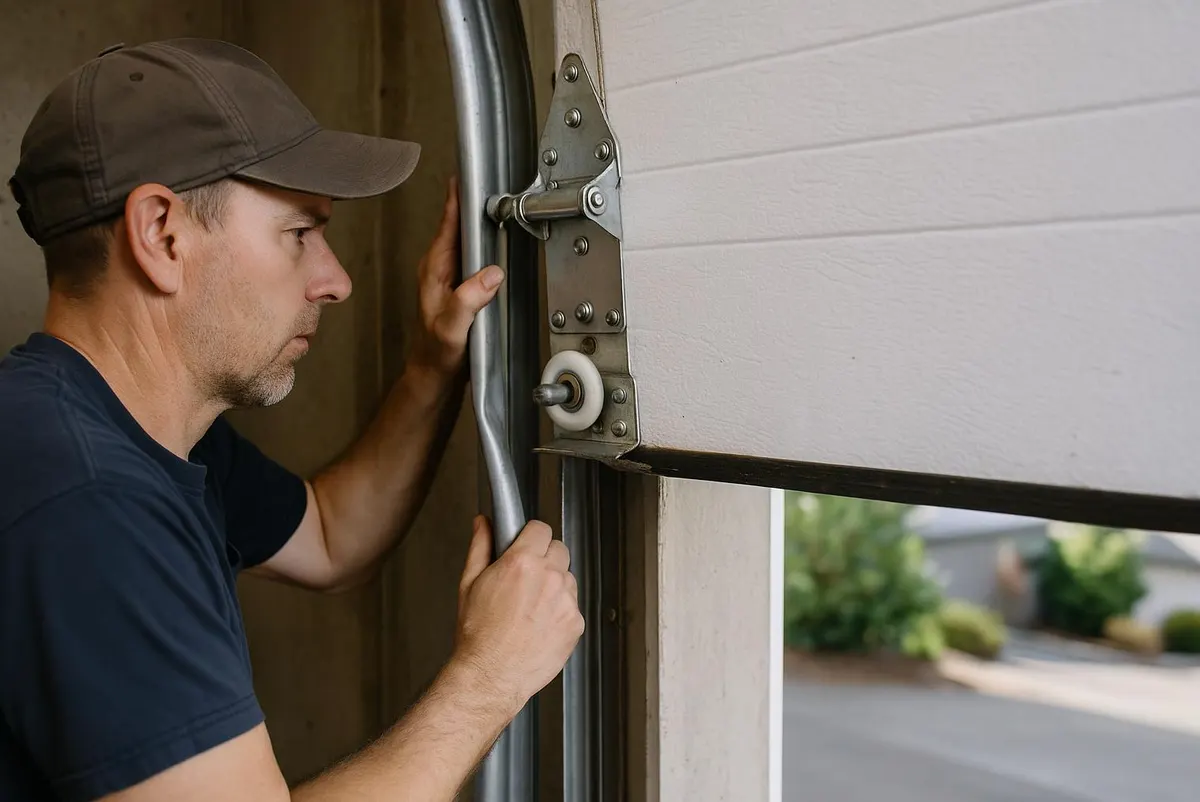
If a door needs more force to close, something mechanical is fighting it: a weakening spring, a bent track, a roller binding in its channel, cables under uneven tension, or a door that's swollen or warped from humidity. Raising the force setting doesn't fix any of that — it just makes the motor push harder against the problem.
- Stripped gears: opener gears are plastic by design, so they fail before the motor burns out. Forcing the unit to overpower resistance wears them out faster.
- Bent track or hardware: if a roller is catching, extra force can bend the track further instead of letting the opener catch the problem early.
- Reduced safety reversal: this is the real risk. A door set to push through resistance may not reverse properly if it contacts a hand, a pet, or a bike leaned against the frame.
- Spring strain: if a spring is losing tension, forcing the opener to compensate puts uneven strain on the opposite side, which can lead to a sudden spring failure rather than a gradual, predictable one.
Signs your settings — or your door — need attention
- The door reverses a few inches before touching the floor
- It closes, then immediately opens a crack on its own
- The opener motor sounds strained or labors audibly during travel
- The door doesn't stop evenly — one side touches down before the other
- It takes noticeably longer to open or close than it used to
Why this matters more here than in other climates
Ocala's humidity and heat cause wood and composite doors to swell slightly during the wettest stretches of the year, which changes how much resistance the door naturally has as it travels. Afternoon downpours and hurricane-season humidity swings can shift that resistance week to week, so a door that closed fine in the dry season may suddenly seem to "need" more force once summer humidity sets in. That's a seasonal mechanical issue, not something a force dial should be covering for — and with wind-load requirements for garage doors in storm-prone areas, a door that isn't moving and sealing correctly is also a door that won't perform the way it's rated to during high wind.
How to check your settings safely
- Disconnect the opener using the release cord and move the door by hand. It should move smoothly with even resistance top to bottom. If it's heavy, uneven, or catches, that's your mechanical problem — not a force setting problem.
- Reconnect the opener and run the auto-reverse test: place a 2x4 flat on the ground where the door closes. The door should reverse immediately on contact. If it doesn't, the force is set too high or the safety sensors need attention.
- Watch the full travel cycle. Note exactly where it stops short, reverses, or strains, so you can describe it precisely if you call for service.
When to call Ocala Door & Opener
If the door doesn't move smoothly by hand, if the auto-reverse test fails, or if you've already tried adjusting the force and the symptom keeps coming back, it's time to call us. We'll check spring tension, track alignment, and cable condition as part of a Garage Door Maintenance & Tune-Up, and if the opener itself is worn out or mismatched to the door's weight, we handle Garage Door Opener Installation with the limits and force set correctly from day one — not guessed at with a dial.
If you're in Ocala, Belleview, Silver Springs, Dunnellon, The Villages, Marion Oaks, Summerfield, or Anthony and your opener is fighting your door, give Ocala Door & Opener a call. We'll find the real problem, fix it right, and get your door back to closing the way it's supposed to.